Another trip in search of waders, travelling a little further from East London this time for a longer day in the field - not much further as the birds fly though, we were more or less just across the Thames at the RSPB reserve at Cliffe.
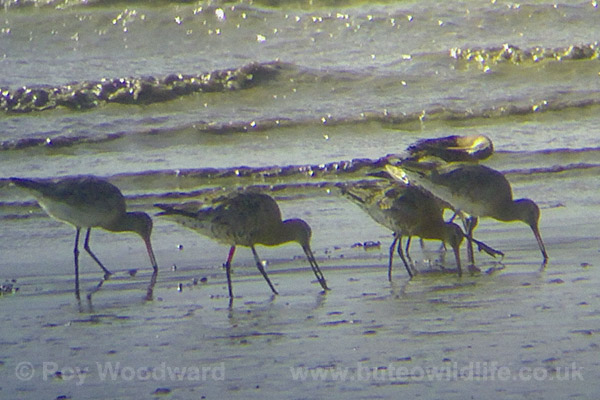
It was high tide when we arrived, which meant that large numbers of Black-tailed Godwits and Common Redshank were roosting on some of the islands in the freshwater pools, or feeding in the shallow areas. Scanning through these soon revealed small numbers of Dunlin and, seemingly tagged on to the largest group of Dunlin, a single juvenile Little Stint. The stint could seen to be clearly smaller than the Dunlins that could be seen in the same telescope view, and with the obvious pale 'braces' on the back that is a plumage feature of juveniles of a few similar wader species.
Several Greenshank were also found, including a colour ringed individual, although most of these seemed to be keeping separate from most of the other waders. By the end of the day we had probably seen a minimum of 30 on the various pools. All of these species were seen before we had even passed the first pool, and we added Common Sandpiper and a Spotted Redshank, which flew over calling, before we continued. On the other pools the waders kept coming, with Avocets, Green Sandpipers, Common Snipe, and at least three Wood Sandpipers. The latter were a 'lifer' for Chris, who was with me, and the presence of both juvenile, and breeding plumaged adult Green Sandpipers nearby allowed a good comparison of the identification features - breeding plumaged Green Sandpiper in particular can often be quite noticeably spotted above, and are sometimes mistaken for Wood Sandpipers.

We diverted our attention briefly from the birds to have a look at some of the invertebrates on the site, in particular looking for some of the dragonfly species that were present, although (as always) other invertebrates were also of interest.
A Migrant Hawker dragonfly landed not too far away, but on the other side of a ditch, and stayed long enough for some good 'scope views and a couple of 'phone scoped' images, and a few Scarce Emerald Damselflies were to be found in the same ditch, as well as more widespread damselfly species such as Blue-tailed Damselflies. We also found a Short-winged Conehead (a type of cricket) at the edge of the ditch, and found both Ruddy Darters and Common Darters.


Back to the birds, Reed Warblers, Sedge Warblers, Blackcaps, and Common Whitethroats were lurking in the reed edges and in bramble and hawthorn scrub, and a couple of Stock Doves also put in an appearance. When we reached the Thames foreshore there were Grey Plovers, Avocets and Shelduck present as well as a variety of gulls.

A prolonged sunny spell brought Marbled White Butterflies and Large & Essex Skippers out, and also seemed to entice many of the ant colonies to fly. Warm sunny days are what the newly mature virgin queen ants, and the flying males, require at this time of year before they leave the nests in which they were raised and mix with ants from other colonies on their mating flights. After mating the females will lose their wings and seek out somewhere to start a new colony and the males will die.
The precise environmental conditions that lead to these mating flights do not seem to be fully understood, but whatever they are they tend to trigger the emergence of flying ants from all of the nests in a given area. Birds quickly learn to take advantage of events such as this, and within minutes large numbers of Black-headed Gulls had gathered, milling around in the sky as they snapped up as many ants as they could. Once the first gulls had begun to gather, others made a bee-line straight for them, with the result being that all those that had been foraging on the foreshore were soon over the land and trying to catch ants. In excess of 200 Black-headed Gulls were soon in the air over the reserve, as well as a handful of Lesser Black-backed Gulls, a single adult Common Gull (scarce in the region at this time of year), and surprisingly at least 5 Common Terns - I have never seen terns feeding on flying ants before but these were clearly doing just that. It was quite surprising how quickly the gulls dispersed again a while later when it clouded over again.

Later sunny spells, one of which happily occurred as we were passing some Buddleia bushes, brought numerous butterflies out, including a single Painted Lady (perhaps a newly arrived migrant?), and a Common Lizard also showed itself briefly. A mouse, presumably a Wood Mouse, was seen briefly running down the trunk of an Elder bush, where it has presumably been feeding, and rustling noises in the bushes almost certainly indicated the presence of other rodents which remained unseen.


A final highlight was a juvenile or female Common Redstart which showed itself briefly at the edge of the path as we passed through an area of bushes on our way back to the car park.